
Organizational Essentials Survey Overview
Are you looking for an alternative to big-name employee engagement survey and culture survey providers? Organizational Essentials offers a practical, cost-effective way to understand how your organization is really functioning — and where meaningful improvement can begin.
Instead of waiting months for high-level reports, Organizational Essentials focuses on team-level insights that lead directly to action. The assessment highlights common challenges found in traditional surveys and shows how a more focused approach delivers clearer, more useful insight into team dynamics, leadership, and overall performance.
Traditional vs. Organizational Essentials Survey Comparison
Many organizations rely on traditional employee engagement surveys to understand engagement and performance, yet struggle to turn results into timely action. The comparison below highlights how Organizational Essentials differs in approach, ownership, and impact.
Traditional Organizational Survey Overview
In many organizations, employees complete a broad survey intended to measure both team dynamics and the organization as a whole. Leadership reviews the results and assigns a committee to analyze the data and recommend improvements. An action plan is developed and eventually presented back to leadership. By the time an organization-wide plan for change is communicated, three to four months have often passed since the original survey.
Focus groups may be used to validate findings, and resources are directed toward large, centralized initiatives. However, employees often expect more visible ownership and follow-through. When progress feels slow or unclear, engagement declines, and attention soon shifts toward preparing for the next annual survey cycle.
Organizational Essentials Survey Overview
What sets Organizational Essentials apart is its emphasis on team ownership and accountability. Rather than relying on generalized, leadership-controlled data, each team receives insight specific to their own work and is empowered to act on it directly.
When team members complete the survey, they focus on their immediate team or area of responsibility. Optional team-specific questions can be included, ensuring the data is relevant, practical, and actionable. This localized approach makes the results more meaningful and places responsibility for improvement where it can have the greatest impact.
Teams receive their results immediately upon completion of the survey. This timely feedback enables teams to begin improving performance and engagement right away. The process is not just about collecting data — it is about initiating real-time improvement and building momentum.
All team-level data is then aggregated into Organizational Essentials Themes, which inform broader organizational initiatives while team-level improvement efforts are already underway. This ensures that both short-term action and long-term strategy are guided by clear, actionable insight.
Organizational Essentials Themes
Organizational Essentials data is organized into six core Themes that reflect how work gets done, how teams function, and how leadership and systems support performance across the organization.


Organizational Output
The purpose of an organization is to create results — we refer to this as Organizational Output. This theme of the report examines how the organization is achieving results and how effectively work is aligned to produce meaningful outcomes. Organizational Output sub-components include goal clarity and alignment, productivity and measurement, work identity, and meaningful work. Together, these areas help organizations understand how performance expectations and outcomes influence employee engagement. This Organizational Essentials component consists of 35 questions.

Organizational Effectiveness
A fundamental team assumption is that when team members work well together, organizational performance improves. Organizational Effectiveness measures how people work together within teams and across the organization. This theme focuses on behaviors and interactions that shape organizational culture. Organizational Effectiveness sub-components include communication, trust, collaboration, innovation, conflict resolution, mutual accountability, commitment, and cohesion. This Organizational Essentials component consists of 21 questions.

Individual Contribution
To earn organizational membership, an individual must perform his or her duties to the fullest degree possible. Individual Contribution examines the role each person plays in supporting performance and alignment. Sub-components include skill level, talents, attributes, personal accountability, attitudes, and motivation of the individual. This theme also considers how individuals live the organizational values, strive toward achieving the vision, and contribute to the mission of the organization. Together, these factors help organizations assess organizational culture at the individual level. This Organizational Essentials component consists of 33 questions.

Structure
For an organization to operate efficiently, clear structures, processes, procedures, and guidelines must be in place. Structure examines how work is organized and supported across the organization. Sub-components include group norms and guidelines, coordination, planning and decision making, roles and responsibilities, and documentation. Together, these elements influence how teams function and provide insight into how organizations measure employee engagement through systems and processes. This Organizational Essentials component consists of 19 questions.

Leadership
Leadership is defined as both the management and leadership of an organization. There is a clear relationship between effective team leadership and overall organizational performance. Great leadership gets great results, and poor leadership gets poor results. This theme examines how leadership behaviors influence direction, decision-making, and accountability, which are central to any organizational culture assessment. Leadership sub-components include direction from the leader, leadership approach, and feedback from the leader. This Organizational Essentials component consists of 20 questions.

Organizational Support
Team performance depends on the level of organizational support provided. Teams require intra-organizational support, adequate resources, sufficient budgets, dedicated team time, necessary training, functional support, and leadership backing. For higher performance, teaming must be embedded in the organizational philosophy, including mission, vision, values, and culture. Organizational Support sub-components include resources and support, organizational recognition, and inter-team dynamics. Together, these elements reflect why employee engagement surveys are important for identifying gaps that affect team effectiveness. This Organizational Essentials component consists of 15 questions.
Ready to create meaningful change in your organization?
See how Organizational Essentials turns insight into action.
Organizational Essentials Report Details
The Organizational Essentials Report is a comprehensive examination of your organization’s performance. The report provides a roll up of all individual Team Essentials data, offering a clear view of how teams and the organization are functioning overall. This roll-up approach reflects how an employee engagement survey is analyzed across multiple teams, beginning with an organizational team breakout that allows for comparison at both the organization and team level. The data is then presented through the seven Key Success Factors of Organizational Performance, followed by each factor and its related sub-components.
Understanding Your Organizational Essentials Report
For a deeper understanding of your organization’s performance and how employee engagement is measured, the Organizational Essentials Report compares your results with our extensive database of Team Essentials participants. The report includes the Lists of 10: your top ten results, bottom ten results, and the most debatable ten items in your survey. The most debatable list highlights areas with the most disagreement or inconsistency within your organization.
The appendix provides a comprehensive ranked listing of all assessment items along with their standard deviations. It also includes an action planner that guides participants through the process of enhancing organizational performance.
Ready to take action? Click below to boost your organization’s overall performance!
Team Essentials vs. Organizational Essentials
Team Essentials
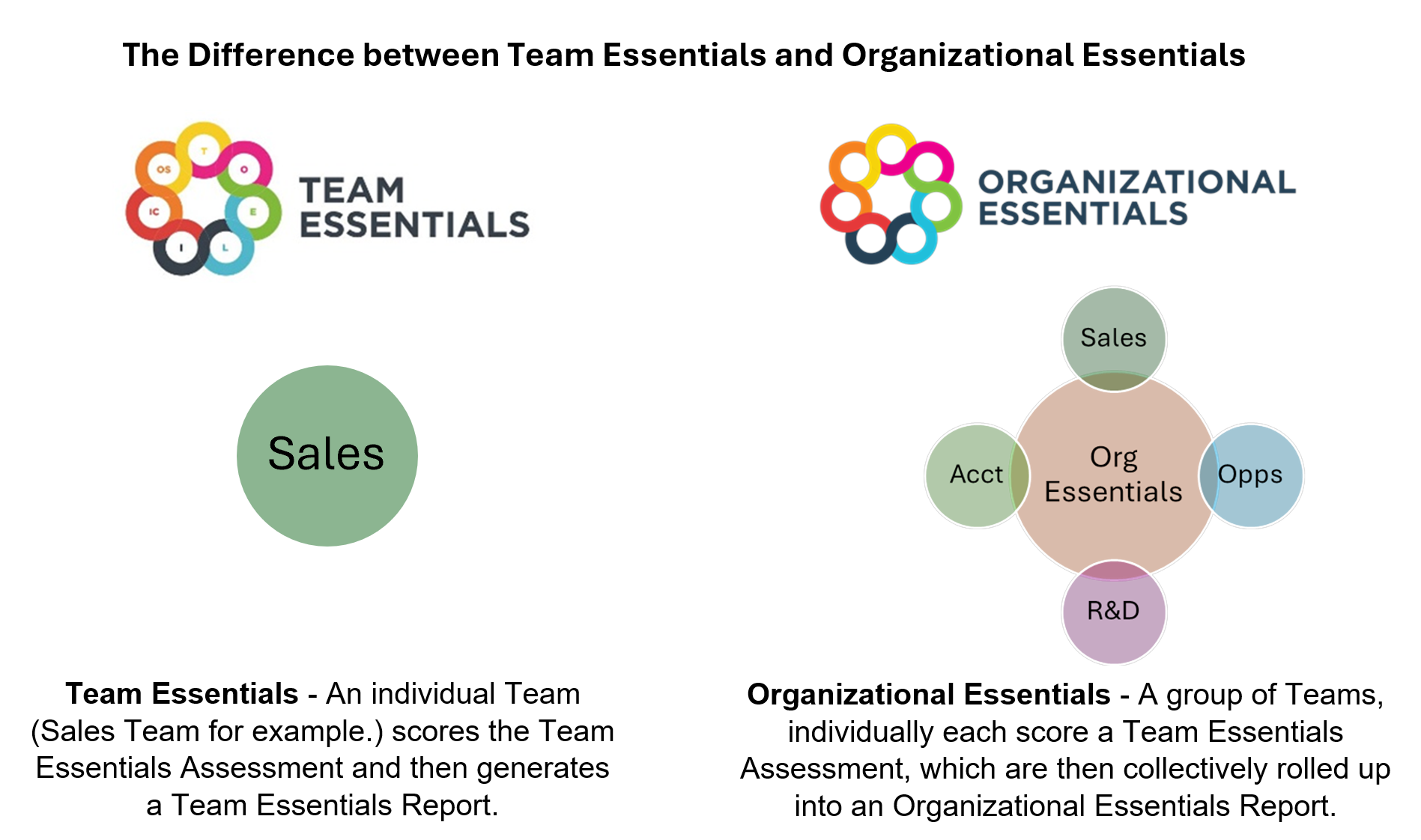
Team Essentials focuses on the performance of an individual team. Each team completes the Team Essentials assessment independently and receives a dedicated report that reflects how that specific team is functioning, collaborating, and performing.
This approach is ideal for understanding team-level strengths and challenges in areas such as communication, accountability, and effectiveness.
Organizational Essentials
Organizational Essentials builds on the Team Essentials model by assessing multiple teams across an organization. Each team completes a Team Essentials assessment, and the results are then aggregated into a single Organizational Essentials report.
This provides leadership with a clear, organization-wide view of patterns, alignment, and opportunities for improvement while preserving team-level ownership and accountability.
Want to see what your results will look like?
Turn your results into clear, actionable improvement.