

Team Essentials Assessment Overview
Our Team Essentials Assessment is a research-based team performance assessment designed to help leaders understand, measure, and improve how their teams work. Developed by Dr. Tim Buividas, a leading Team Performance Expert, this model evaluates seven essential success factors that provide a clear, structured way to assess team performance. Each factor is divided into measurable sub-components, giving leaders reliable insights into both team output and team effectiveness.
Independently validated by the University of Illinois Chicago, the Team Essentials Assessment offers a highly reliable method for evaluating team performance and identifying opportunities for growth.
The Seven Team Essentials Factors


Team Output

Team Effectiveness
A basic team assumption is that if team members work well together, team performance will be enhanced. Team Effectiveness measures how people work together, which is a core part of any team performance assessment. Team Effectiveness sub-components include communication, trust, collaboration, innovation, conflict resolution, mutual accountability, commitment, and cohesion. These areas provide essential insight for leaders who want to evaluate and monitor team performance and understand how teamwork impacts overall results. This Team Essentials component consists of 21 questions and is offered in both the Complete and Basic Assessment options.

Indvidual Contributor
To earn team membership, an individual must perform his or her duties to the fullest degree possible. Individual contribution sub-components include skill level, talents, attributes, personal accountability, attitudes, and motivation of the individual. These elements play an important role in any team performance assessment, as individual behaviors directly influence overall team results. This section also considers how the individual lives the organizational values, strives toward achieving the vision, and contributes to the mission of the organization. These insights help leaders evaluate team performance by understanding the strengths each member brings to the team. This Team Essentials component consists of 33 questions and is offered only in the Complete Assessment option.

Structure
For teamwork to be efficient, structures, processes, procedures, and guidelines need to be in place. Structure sub-components include group norms and guidelines, coordination, planning and decision making, roles and responsibilities, and documentation. Clear structure provides essential context for any team performance assessment, helping leaders understand how well a team is organized and whether systems support effective collaboration. These elements also contribute to the evaluation of team performance by showing how team processes influence outcomes. This Team Essentials component consists of 19 questions and is offered only in the Complete Assessment option.

Team Leadership
At the team level, leadership is defined as both the management and the leadership of a team. Typically there is a relationship between effective and efficient team leadership and team performance. Great leadership gets great results and poor leadership gets poor results. Leadership sub-components include direction from leader, leadership approach, and feedback from the leader. Because leadership strongly influences team dynamics and outcomes, this area provides meaningful insight during a team performance assessment, helping leaders understand how their approach impacts overall results. These elements also support the evaluation of team performance by highlighting how leadership behaviors shape team effectiveness. This Team Essentials component consists of 20 questions and is offered only in the Complete Assessment option.

Organizational Support
Team performance is dependent upon organizational support. Teams need intra-organizational support, abundant resources, sufficient budgets, dedicated team time, necessary training, functional support, and organizational leadership support. For higher performance, teaming needs to be included in the organizational philosophy (mission, vision, values, and culture). Organizational Support sub-components include resources and support, organizational recognition, and inter-team dynamics. Because organizational systems heavily influence team outcomes, this area provides key context within a team performance assessment, helping leaders understand how well the environment enables team success. These insights also contribute to the broader evaluation of team performance, revealing whether the organization itself supports or hinders effective teamwork. This Team Essentials component consists of 15 questions and is offered only in the Complete Assessment option.

Team Type
Team Type impacts how a team is perceived and how it performs. Team Type is collected as a demographic on the Team Essentials Assessment. In the near future, performance data will be additionally provided specifically by team type. Understanding these variations supports a more accurate team performance assessment, since team structure and context often influence results. Team Type includes team type, duration, location, number of team members, and team relationship, all of which help leaders assess team performance within the appropriate team context.
Two Team Essentials
Assessment Options
1) Team Essentials Complete
The Team Essentials Complete assessment is composed of all seven core components. This assessment provides a full measure of the Team Essentials model and is best used for team performance improvement and development. Team Essentials Complete has an option for a Progress Report that provides a Pre / Post Progress Report that measures gain and gaps in team performance.
The Team Essentials Basic assessment is composed of only Team Output and Team Effectiveness. This assessment provides a basic indication of team performance and gives leaders an initial view they can use as part of a broader team performance assessment or continuous improvement process. It is also the most economical assessment to use.
What types of team situations benefit from a Team Essentials Assessment?
2) Team Essentials Basic
A Team Reset: Leaders can find the root causes of poor performance, not just the symptoms, and determine what to improve.
A Team Jump Start: Managers can get teams off to the right start by learning their strengths and weaknesses. Repeat assessments can measure improved performance and help leaders more effectively assess team performance over time.
Taking a Team to the Next Level: When a team needs to grow and improve, leaders can get a vital baseline and actions to take the team to the next level.
Leadership Coaching: Team Essentials is an exceptional tool for gathering feedback for coaching leaders. It complements most Leadership Coaching Approaches and supports a more rounded evaluation of team performance during coaching engagements.
Ready to give it a try?
Team Essentials Report Details
The Team Essentials Report is a comprehensive examination of your team’s performance. The report provides a high-level view of your team’s results, beginning with the 6 Key Success Factors of Team Performance and then breaking down each factor and its sub-components. For a deeper understanding of your team’s performance, your results are compared to our overall database of Team Essentials participants, giving leaders meaningful context for interpreting the findings and supporting a clear, research-based team performance evaluation.
Click on any image to enlarge it for a clearer view of your team’s results.
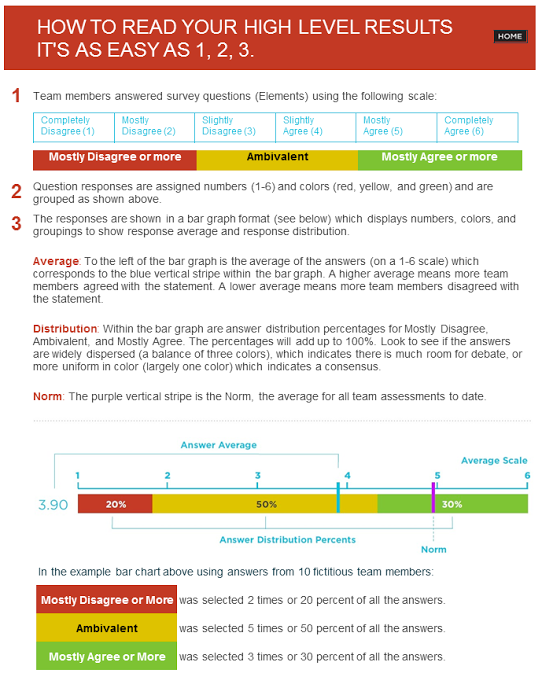
LEGEND
The legend helps you understand how each chart represents response patterns and performance insights.

OVERALL RESULTS
6 TEAM ESSENTIALS
This page provides a dashboard of your team’s performance. It is the entry point for discussing the team’s overall results across the 6 Team Essentials factors. These results offer leaders a clear starting point for interpreting the report and understanding the broader context of their team performance evaluation.

RANKED LIST OF 6 TEAM ESSENTIALS AND THEIR SUB-COMPONENTS
This ranked listing provides an overall look at the specific sub-components. This page provides a quick view of your team’s performance. Normed data is also provided so you can see how your team’s performance compares to other teams in our database. These comparisons offer additional context that supports a clearer understanding of your team’s strengths and opportunities for improvement.

LIST BY INDIVIDUAL
TEAM ESSENTIAL AND
SUB-COMPONENT
Each of the Six Essentials has a report section that provides the overall result for the Essential, along with the results for each Essential sub-component. Narrative comments are also provided in each of these sections, giving additional context behind the team’s scores and highlighting areas of strength or potential improvement. These detailed insights support a more complete understanding of your team’s results as part of a broader team performance evaluation.
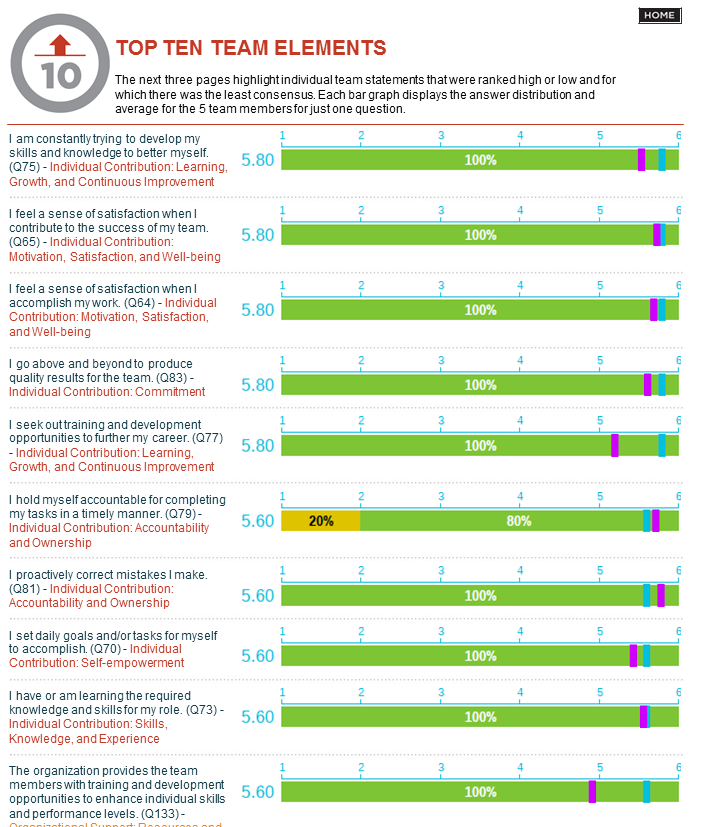
TOP TEN LIST
The following is a listing of the top 10 Elements for your team. Overall, your team members clearly agree that your team is doing well with each of these elements. These results highlight your strongest areas in the team performance assessment and show where the team is most aligned. It is important to discuss what your team can do to continue doing well in these areas of strength and to determine any next step actions to maintain or improve in these areas.

BOTTOM TEN LIST
The following is a listing of the bottom 10 Elements for your team. Overall, your team members clearly agree that your team is not doing well, or feel that it may not be important with each of these elements. These results indicate potential challenges highlighted in your team performance evaluation and can help identify areas that may need attention. It is critical to discuss what your team is not doing well and to determine next step actions to improve in these areas.
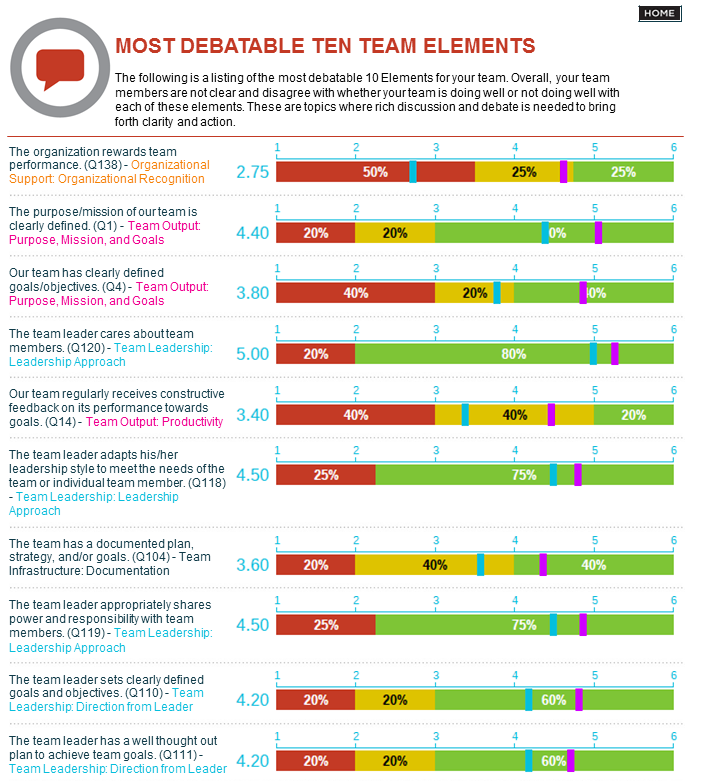
MOST DEBATABLE TEN LIST
The following is a listing of the most debatable 10 Elements for your team. Overall, your team members are not clear and disagree on whether your team is doing well or not doing well with each of these elements. These mixed responses often highlight areas where additional insight from your team performance assessment can help guide understanding. These are topics where rich discussion and debate are needed for clarity and action.
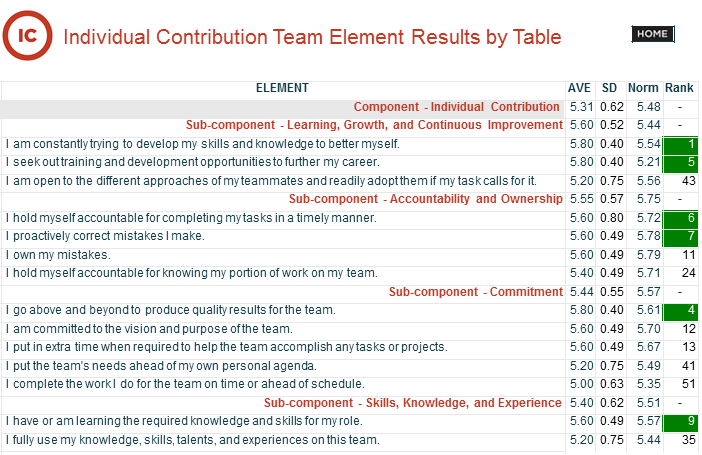
RANKED LIST OF EACH ITEM
This report section is for those who love data. These detailed results compare and rank each assessment item (question). This level of detail offers helpful insight for leaders who want a deeper look at the patterns revealed in the team performance assessment. This page also details the standard deviations of the items.
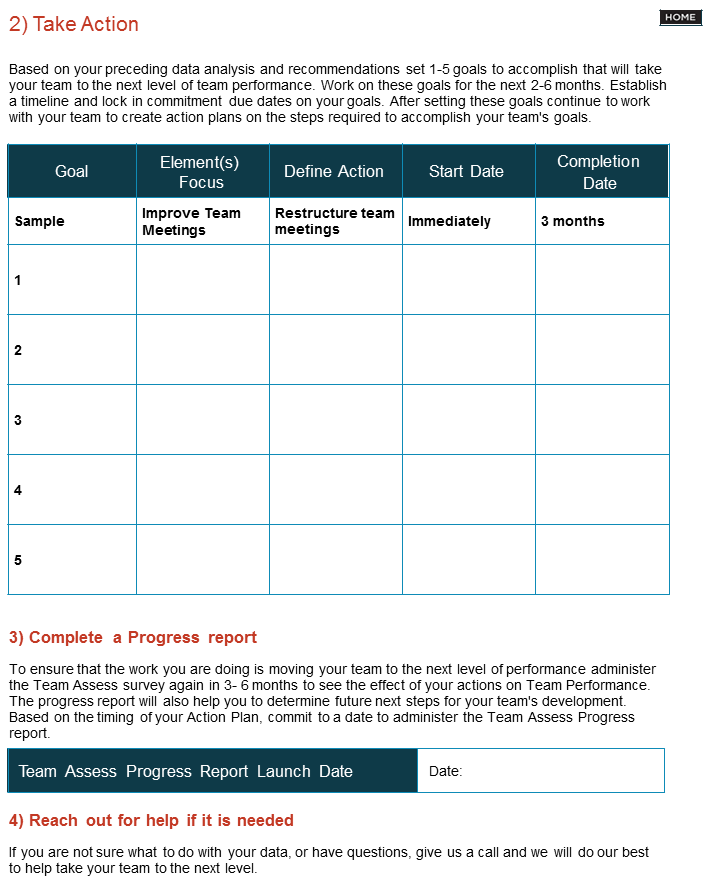
ACTION PLANNER
Taking a Team Assessment is useless, and can cause a decrease in performance, if it is not acted upon. The key to increased team performance is to create an improvement action plan that is executed upon. Your report provides an abundance of data to work on. The key is to narrow down your results into actionable steps to improve team performance. These insights help connect your results from the team performance assessment to practical next steps. It is better to choose a few items to work on than it is to choose too many.
There are a few ways to approach your improvement action planner. The data can be shared with your team and worked on together. The action planner can be solely completed by the leader. And you can engage a team coach to facilitate your next steps and improvement plan.
Want to see what your results will look like?
Click the link below and get started!